

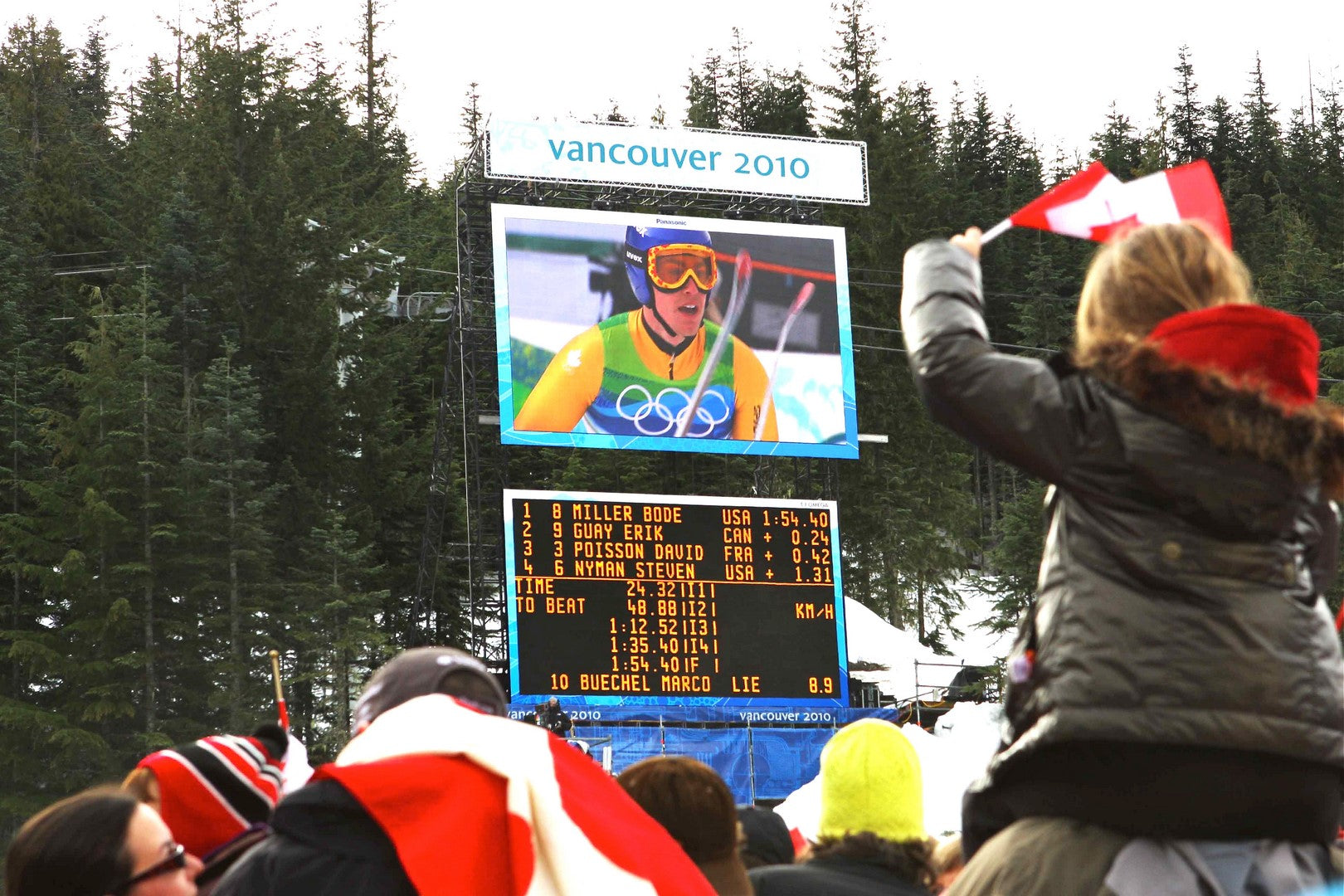
Giant LED screen technology
The SUPERVISION team is dedicated to explaining the essentials of giant LED screen technology and offers you a thematic glossary to better understand the various terminologies and to shape your projects according to your choices and expectations.
These answers will allow you to better understand this technology and thus optimize your value for money and guarantee the long-term success of your project.
LED screens are made up of LEDs (diodes) forming pixels assembled on matrices or panels. These are then mounted on cabinets that form the giant screen. These screens maintain perfect video rendering without visible seams regardless of the viewing distance. The robust and completely waterproof outdoor screens withstand the most extreme conditions: altitude, temperature differences, etc.
Types of LED Giant Screens
The SMD LED giant screen

SMD technology visually groups the three LEDs (red, green, blue) into a single white or black color point.
High contrast (especially in the Full Black version), incomparable color fidelity, unrivaled resolutions... Its properties make it a must-have today and are found in almost all of our screens.


REAL PIXEL (or fixed) / VIRTUAL PIXEL (or dynamic)
In screen configuration, there are 2 types of component implementation, creating either a real pixel pitch or a virtual pixel pitch.
The pixel pitch is "real" when each LED operates for a single and unique pixel.
It is "virtual" when each LED participates in the rendering of 2 pixels. The virtual pixel shares a green LED and a red LED with its left neighbor, in the same way it shares the blue LED and the other red LED with its right neighbor.
In conclusion, a screen with a "real" pixel pitch of 10 mm will certainly provide a quality image. In comparison, a "virtual" 10 mm screen will undoubtedly offer financial advantages, but in practice will produce a lower quality image.
The resolution

The resolution of LED screens is equivalent to the number of pixels (or dots), in other words, the pixel density per m² in the display area of the screen.
The higher the screen's resolution, the shorter the readability distance* will be without image degradation.
The combination of the parameters "minimum distance**/maximum distance*** – resolution" will determine the size of the giant screen suitable for your configuration.*Readability distance: distance between the audience and the giant screen.
**Minimum distance: distance between the closest viewer and the giant screen.
***Maximum distance: distance between the furthest viewer and the giant screen.


